


Guide to Avoid Pitfalls in Jewelry Display Cabinets: Three Key Designs for Scratch-proof, Anti-theft, and Oxidation-resistant Performance
With its bright luster and precious value, jewelry has become a carrier of emotions and wealth. As the "exclusive palace" for jewelry, jewelry display cabinets are not only a visual focus that attracts customers but also directly related to the safety and quality preservation of jewelry. Many practitioners, when purchasing or customizing display cabinets, often overlook core design details and fall into the dilemma of "meeting the aesthetic standards but lacking practicality" — problems such as obvious scratches on the glass, ineffective anti-theft designs, and jewelry losing its luster due to oxidation occur frequently. This article will focus on the three core pain points of scratch resistance, anti-theft, and oxidation resistance, and break down the key points to avoid pitfalls in jewelry display cabinets from the perspectives of functional design, material selection, process details, and lighting matching, providing professional references for practitioners.
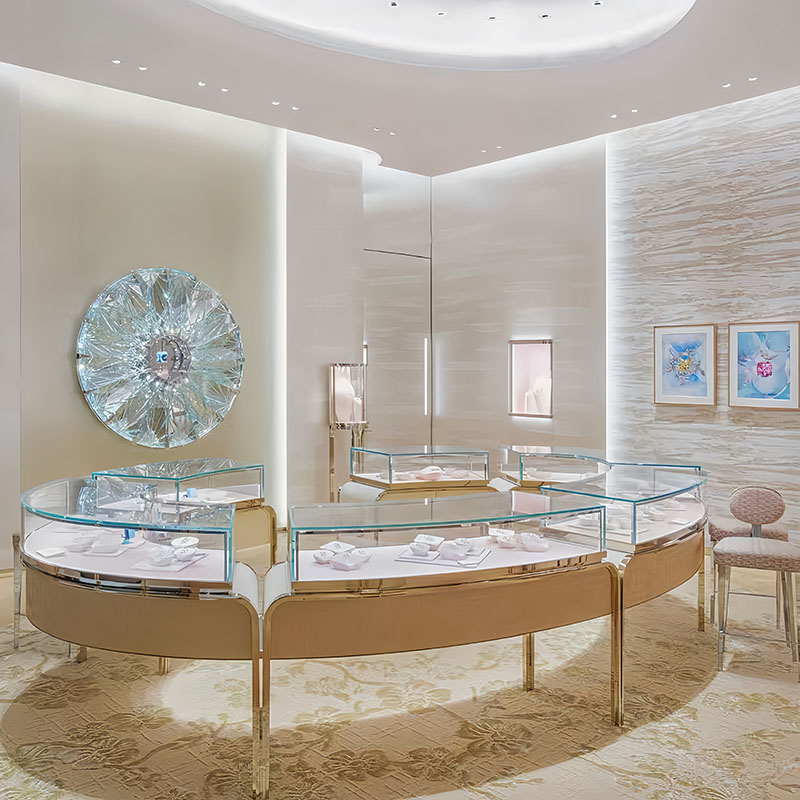
I. Scratch Resistance: Safeguarding Transparent Texture and Rejecting "Defects" That Reduce Appeal
1. Material Selection: Prioritize High-hardness and Wear-resistant Materials
Ultra-white tempered glass: Known as the "golden material" for jewelry display cabinets, its Mohs hardness can reach 6.5-7, and its impact resistance is 3-5 times that of ordinary glass. It can not only resist daily friction but also avoid breaking even when subjected to slight impacts. At the same time, the light transmittance of ultra-white glass is as high as over 91.5%, which can maximize the restoration of the jewelry's true color and avoid the "color deviation" problem of ordinary glass. When purchasing, it is necessary to confirm whether the glass has the 3C certification mark to prevent shoddy products.
2. Process Protection: Detail Handling to Reduce Wear Risks
Scratch-proof acrylic (PMMA): If the budget is limited or a special-shaped display cabinet is needed, high-purity scratch-proof acrylic can be selected. Its Mohs hardness is about 2-3, but it can be increased to 4-5 after surface coating treatment. Moreover, its weight is only half that of glass, making it suitable for hanging or mobile display scenarios. It should be noted to avoid acrylic made from recycled materials, as such materials are prone to yellowing and embrittlement, and obvious scratches will appear after short-term use.
Edge precision grinding process: The edges of glass or acrylic must undergo precision grinding and chamfering treatment to avoid sharp edges causing gaps due to collision during transportation or use, which may lead to large-area scratches. The edges of high-quality display cabinets feel smooth without burrs or unevenness.
3. Functional Design: Replaceable Panels to Extend Service Life
Anti-fingerprint coating: Spraying a nanometer anti-fingerprint coating on the glass surface can not only reduce fingerprint marks left by customers' touches and lower the cleaning frequency but also form a wear-resistant protective film to improve surface hardness and reduce wear caused by cleaning cloth wiping. When purchasing, you can test it on the spot: press it with your finger and then wipe it — if the mark can be easily erased without residue, it is a qualified coating.
II. Anti-theft: Building a Solid Security Line to Safeguard the Value of Jewelry
1. Structural Design: Blocking Intrusion Paths from the Cabinet Frame
Frame material: Cold-rolled steel plates are preferred for the cabinet frame, with a thickness of at least 1.2mm. Their impact resistance and pry resistance are far superior to aluminum alloy or wooden frames. Some high-end display cabinets adopt a composite structure of "steel plate + solid wood", which ensures safety while taking into account aesthetics. When purchasing, you can judge by tapping the cabinet — the sound of a steel plate frame is crisp, while that of a wooden or aluminum alloy frame is dull.
2. Lock System: Reject Ordinary Locks and Choose Multi-dimensional Protective Locks
Pry-proof structure: The connection between the cabinet door and the cabinet body should adopt an "embedded pry-proof design", that is, the cabinet door fits seamlessly with the cabinet body after closing, avoiding gaps that provide space for prying tools. At the same time, the edge of the cabinet door should be equipped with a pry-proof sealing strip, which can not only enhance the sealing performance but also generate resistance when the door is pried, prolonging the breaking time.
Intelligent electronic locks: Supporting multiple unlocking methods such as fingerprint, password, and card swiping, they can record the time and personnel information of each unlocking for convenient management. Some high-end models also have an "error alarm" function — if the password or fingerprint is entered incorrectly three times in a row, an acousto-optic alarm will be triggered automatically, and an early warning message will be sent to the bound mobile phone.
3. Intelligent Early Warning: Realizing "Proactive Anti-theft"
Dual-lock linkage design: For display cabinets storing high-value jewelry, a dual-lock design of "main lock + auxiliary lock" is recommended. The main lock is used for daily opening, while the auxiliary lock is hidden inside the cabinet and can only be opened with special tools, providing double protection to reduce the risk of theft.
Vibration sensor: When the cabinet is subjected to vibrations such as impact or prying, the sensor will immediately trigger an alarm, with an alarm volume of over 80 decibels, and at the same time link with the shopping mall's security system.
III. Oxidation Resistance: Maintaining Jewelry Luster and Extending Its Freshness Period
Glass break detector: Installed inside the display cabinet, when the glass is broken, the detector will instantly identify it and send an alarm signal, preventing thieves from stealing jewelry by breaking the window.
1. Sealing Process: Blocking the Invasion of External Harmful Gases
Cabinet door sealing: Food-grade EPDM rubber strips are used as sealing materials. They have good elasticity and aging resistance, can fit the cabinet door and cabinet body tightly, and effectively block the entry of air and moisture. When purchasing, you can check whether the rubber strip has an odor and fits tightly — you should feel an obvious "sealing feedback" when closing the cabinet door.
2. Materials and Functions: Regulating the Internal Environment to Inhibit Oxidation Reactions
Cabinet body splicing: The splicing parts of the cabinet body must adopt a seamless welding process to avoid gaps. Some low-end display cabinets use screw splicing, and the screws are prone to loosening after long-term use, leading to gaps, which must be avoided.
Internal lining material: Acid-free and sulfur-free environmentally friendly materials should be selected. For example, flannelette must undergo anti-corrosion treatment to prevent harmful gases released by the lining from causing jewelry oxidation. Ordinary cotton or chemical fiber linings should be avoided, as they are prone to absorbing moisture and may contain sulfides.
IV. Lighting Design: Adapting to Jewelry Characteristics and Balancing Aesthetics and Protection
Constant temperature and humidity function: For high-end jewelry display cabinets, it is recommended to be equipped with a constant temperature and humidity system, which controls the internal temperature at 20-25℃ and the humidity at 40%-60% — this range can maximize the inhibition of oxidation reactions. Professional moisture absorbers can be placed in ordinary display cabinets, but they need to be replaced regularly to prevent increased humidity after they become ineffective.
Oxygen removal module: For easily oxidized jewelry such as silver jewelry, display cabinets with oxygen removal modules can be selected. By reducing the oxygen concentration inside, the risk of oxidation is reduced from the root. Attention should be paid to replacing the oxygen removal module regularly during use to ensure its effectiveness.
1. Light Source Selection: Reject Ultraviolet Rays and Control Heat
LED cold light source: As the best choice for jewelry display, LED lights have no ultraviolet radiation, low heat, and a long service life. When purchasing, attention should be paid to the color temperature — cool white light of 5500-6500K is suitable for diamonds and platinum, which can highlight their fire; warm white light of 3000-4000K is suitable for gold, rubies, and sapphires, which can enhance their warm texture.
2. Lighting Layout Design: Layered Lighting to Highlight Key Points
UV-proof glass cover: If the display cabinet uses an external light source, a UV-proof coating should be added to the inner side of the glass panel, or ultra-white glass with UV-proof function should be selected to double block UV damage.
Main light: Installed on the top of the display cabinet, a diffused light source is used to provide uniform basic lighting, avoiding direct light on the jewelry to cause glare.
3. Intelligent Functions: On-demand Regulation for Energy Conservation and Protection
Auxiliary light: Embedded spotlights are installed on the side of the cabinet or under the laminate to provide local supplementary lighting for key displayed jewelry, highlighting its details and luster. The spotlights should be of adjustable angle type to facilitate adjusting the light direction according to the position of the jewelry.
V. Summary of Pitfalls to Avoid: Core Purchasing Checklist


0086+189-8899-0175(Bill)

0086+189-8899-0175(Bill)


+0086+189-8899-0175(Bill)

0086+189-8899-0175(Bill)


